Spiga

Bookmark and Share   
Showing posts with label Backpacking. Show all posts

An Óige

An Óige

An Óige (literally youth in Irish), or the Irish Youth Hostel Association (IYHA) is the Hostelling International's association for the Republic Of Ireland.

An Óige was founded in 7 May, 1931 by Thekla Beere (as part of an organising committee) as a membership based organization and is a member of the International Youth Hostel Federation. The headquarters are located in Dublin at 61, Mountjoy Street an eight-minute walk from O'Connell Street and less than an hour by Dublin Bus (16A or higher with Airlink) from Dublin Airport.

An Óige operates (as of early 2009) 27 youth hostels in the Republic of Ireland, some of which are only open in the summer season. The hostels in Dublin, Cork or Galway, are open all year round as well as hostels in Fossa in Killarney, County Kerry; Cong in County Mayo, in Gweedore in County Donegal and in Glendalough in County Wicklow.

The first youth hostel was opened in 1931 in Lough Dan (Irish: Loch Dean), near Round Wood (Irish: An Tochar), in County Wicklow (Irish: Cill Mhantáin).

Objective

To help all, but especially young people, to a love and appreciation of the countryside, particularly by providing simple hostel accommodation for them whilst on their travels.

From http://en.wikipedia.org/

American Youth Hostels

American Youth Hostels, Inc. is a 501(c)(3) nonprofit membership organization founded in 1934, whose formal name is Hostelling International USA (abbreviated "HI-USA"). It is the American member of Hostelling International. It is incorporated in Albany, New York.

Youth hostels offer inexpensive temporary accommodations around the world for travelers. Generally, the rooms are dormitory style.

Offices

American Youth Hostels, Inc. is incorporated in Albany, New York under New York's not-for-profit law. Its executive offices are in Silver Spring, Maryland.

The flagship residence of the American Youth Hostels in the United States is in New York City, located in a landmark building designed by noted architect Richard Morris Hunt. This popular hostel occupies the entire east blockfront of Amsterdam Avenue between 103d and 104th Streets in Manhattan.

The second largest hostel operated by American Youth Hostels is in Chicago, Illinois.

Mission

The official mission of HI-USA is "to help all, especially the young, understand the world and its people through hostelling."

According to the HI-USA web site:

HI-USA operates a network of nearly 80 quality hostel accommodations throughout the United States that are inexpensive, safe and clean. Our hostels range from urban high-rise buildings with hundreds of beds to small more remote hostels in rural settings.
HI-USA, in cooperation with other national associations worldwide, belongs to the International Youth Hostel Federation (IYHF). This entire network, known as Hostelling International, offers more than 4,000 hostels in over 60 countries. Hostelling International USA and the blue triangle with the tree and hut are the trademark and seal of approval of the IYHF, assuring travelers quality, affordable accommodations that are routinely inspected and travel programs worldwide.
HI-USA is also associated with 31 councils throughout the United States. These councils provide local members and visitors with a wide range of special programs, events, trips and activities."


Annual National Council Meeting

The American Youth Hostels, Inc. holds its annual convention, the National Council Meeting (NCM) in November of each year. In 2007, the NCM was held in Washington, D.C., and the keynote speaker was Brook Silva-Braga, the documentary film-maker.

From http://en.wikipedia.org/

Lillian Alling

Lillian Alling was a Russian immigrant who tried to return to Russia from New York, USA mostly on foot.

Description from a book by Calvin Rutstrum

The following is an excerpt from Calvin Rutstrum's The New Way of the Wilderness (1958):

"In the summer of 1927, Lillian Alling, a young Russian immigrant, homesick and compelled to perform menial tasks for a living in New York, made up her mind to go back to her homeland in Europe. Because she had no money for transportation, she decided to hike back to her native country. She tramped to Chicago, to Minneapolis, to Winnipeg, refusing all invitations to ride.

She was next seen on the Yukon Telegraph Trail in the northern part of British Columbia, Canada, a small pack on her back and a length of iron pipe in her hand for protection, heading towards Alaska. The provincial police at Hazelton prevented her from making a winter journey through the Canadian wilds, but they were able to detain her only until spring.

Starting out again, she hiked along the Telegraph Trail, over the wild mountain passes, finally reaching Dawson. There she worked as a cook, purchased and repaired an old boat, and in the spring of 1929, launched it into the waters of the Yukon River right behind the outgoing ice and reached a point east of the Seward Peninsula. There she abandoned the boat for overland travel, reaching Nome and later Bering Strait. She was last heard bartering with the Eskimos for boat passage across the Strait to Asia."

In 2007 Vancouver Opera announced a commission of an opera based on the Lillian Alling story, to be written by John Murrell and John Estacio and to premiere in October 2010.

From http://en.wikipedia.org/

Adventure Life

Adventure Life is an adventure travel company that provides private and small-group tours in Latin America and small-ship cruises throughout the world. They offer over a 100 different itineraries in South America & Central America, and hundreds of small ship cruises to less conventional destinations such as Africa, the Arctic, Antarctica and Alaska.

Their focus is nature, cultural, and active travel and they apply ecotourism principles to their tour and cruise programs. Most trips have a maximum group size of 12, and the average size is 8. Since their founding in 1999, over 16,000 clients have traveled with the company.

Adventure Life is registered in the State of Montana as ALJ, Inc., and they do business as Adventure Life Journeys and Adventure Life VOYAGES.

History

Adventure Life was founded by Brian Morgan in 1999. Morgan was working as a consultant in Quito for CARE in the late 1990s, but decided to return home to Montana. While applying for jobs in Montana, Morgan planned a group tour back to Ecuador and promoted it locally. This experience made him recognize that guided tours were a service in demand, and a niche industry that his own travel experiences and Ecuadorian connections had prepared him to explore further.

Time line:
- 1999: Adventure Life launches in February with Spanish language study-trips, internships, and tours to Peru and Ecuador. Office is initially located in Havre, Montana. Morgan hires first staff member. First year of business, Adventure Life has fewer than 100 travelers.
- 2000: Company decides to focus on offering tours only, and no longer provides Spanish language study-trips, or internships. Office moves from Havre, and settles in Missoula, Montana. By the end of 2000, company hires 4 full-time staff members. Establishes a partner office in Lima, Peru.
- 2001: Adds tours to Bolivia, Costa Rica and Belize. Establishes a second partner office in Quito, Ecuador. The company moves from Morgan's home into its first office.
- 2003: Adds Chile, Argentina, Patagonia and Guatemala to list of destinations. Moves into a new office building, their current location.
- 2005: Adventure Life starts sending travelers on expedition cruises to Antarctica
- 2006: Panama is added to list of destinations. Partners with Rainforest Alliance's Best Management Practices in Sustainable Tourism Program.
- 2007: Company launches Adventure Life VOYAGES, which provide small-ship cruises throughout the world. During 2007, Adventure Life provides trips for over 3500 travelers.
- 2008: Ads the Falkland Islands. Company launches an online community forum offering client Trip Journals - system utilizes the services of Google Maps.

Responsible travel

Galapagos Conservation Fundraising
Adventure Life is an active member of the International Galapagos Tour Operators Association, (IGTOA). The president of Adventure Life, Brian Morgan, is also currently the president of IGTOA. In Nov. 2006, IGTOA they launched a Galapagos traveler-funding program for island conservation, and Adventure Life was one of the first members to adopt this initiative. A voluntary donation is added to all of Adventure Life's Galapagos travelers’ invoices. 40% of this donation goes to IGTOA and 60% goes to the Charles Darwin Foundation. Dollar for dollar, Adventure Life matches these donations with travel vouchers for future trips with their company. As of June 2008, Adventure Life’s travelers have raised nearly $40,000 for island conservation.

IGTOA supports program in the Galapagos that include both Conservation and Professional Standards. Conservation funding is for projects that directly impact issues like introduced species, patrol of the park, and scientific research. Professional Standards relates to boat safety; passenger care; training and treatment of captains and crew members; guide training; educating travelers on conservation issues; and other issues relating to health, safety, and the rights and responsibilities of both travelers and tourist industry personnel.

The Charles Darwin Foundation (CDF) has carried out research for the conservation of the Galapagos ecosystem for almost 50 years. They have been a leader in conservation science and the practical application of information gained and lessons learned in Galapagos, and are one the most respected non-profit research organization currently in operation.

Center for Traditional Textiles of Cusco (CTTC)
The CTTC is a non-profit organization established in 1996 to aid in the survival of Incan textile traditions and to provide support to weaving communities. Working with the Center, Quechua weavers and their families in the region of the former Incan capitol are engaged in skills-building, community networking and market development. By researching and documenting complex styles and techniques of the ancestors, the Center helps to ensure that 2,000 year-old textiles traditions will not be lost to future generations. Adventure Life provides an annual donation to the CTTC, and incorporates visits to the center for all of its Peru itineraries that spend time in the Cusco region.

Awards

* 2008 Employer of Choice winner, Missoula Job Service Employer's Council
* 2007 Best Adventure Travel Companies on Earth, National Geographic Adventure
* 2007 Best in Travel Class, Transitions Abroad
* 2007 Trip of the Year, Outside Magazine
* 2006 Green List Honoree, Conde Nast Traveler
* 2006 Best Trips, Outside Magazine

Media References

Adventure Life has been featured in major publications such as USA Today, The New York Times, National Geographic Adventure, Outside Magazine, ForbesLife and Conde Nast Traveler.

From http://en.wikipedia.org/

Types of backpacking

Types of backpacking

Flashpacking

Flashpacking is a neologism used to refer to affluent backpacker. Whereas backpacking is traditionally associated with budget travel and destinations that are relatively cheap, flashpacking has an association of more disposable income while traveling and has been defined simply as backpacking with a bigger budget.

A simple definition of the term Flashpacker can be thought of as backpacking with flash, or style. One school of thought defines the flashpacker as a rapidly growing segment of travelers who adhere to a modest accommodation and meal budget, while spending freely, even excessively, for activities at their chosen destination. Another school of thought defines flashpacking as an incongruous mix of 'slumming it' and luxury; of adventurous travel with those on a budget by day and sedate dining and comfortable accommodation by night. Flashpackers have been further defined as tech-savvy adventurers who often prefer to travel with a cell phone, digital camera, iPod and a laptop, although none of these is required in order to be a flashpacker. As with other forms of travel, the term flashpacker is mainly one of self-identification. The origin of the term itself is obscure.

The term also reflects a growing demographic of travelers who are forsaking traditional organized travel, venturing to destinations once the reserve of more adventurous backpackers, and the increasing number of individuals who leave well paid jobs or take 'career breaks', using the time to travel independently, but with greater comfort and many of the gadgets they are accustomed to at home. As a result, hostels are evolving and offering more up-market accommodation to those still traveling on a budget in order to obtain their business. The hostels have realized a need to evolve in order to meet the changing demands of travelers.

Gap-packing

"Gap-packing" is a neologism used typically to refer to younger people, usually of European descent, who backpack to several countries in a short period of time whilst on their gap year between school and university, or between university and their first job.

Culture

Of importance in backpacking is a sense of authenticity. Backpacking is perceived as being more than a vacation, but a means of education. Backpackers want to experience the "real" destination rather than the packaged version often associated with mass tourism, which has led to the assertion that backpackers are anti-tourist. There is also the feeling of "sneaking backstage" and witnessing real life with more involvement with local people

Criticism

Backpacking, like other forms of travel, remains controversial. Some of these criticisms date back to travelers' actions along the Hippie Trail. Criticism comes from many sides, including the host countries and other travelers who disagree with the actions of backpackers although the perception of backpackers seems to have improved as backpacking has become more mainstream. Erik Cohen notes that even though one of the primary aims of backpacking is to seek the authentic, the majority of backpackers spend most of their time interacting with other backpackers and interactions with locals are of "secondary importance"

From http://en.wikipedia.org/

Backpacking (travel)

Backpacking (travel)

Backpacking is a term that has historically been used to denote a form of low-cost, independent international travel. Terms such as independent travel and/or budget travel are often used interchangeably with backpacking. The factors that traditionally differentiate backpacking from other forms of tourism include but are not limited to the following: use of public transport as a means of travel, preference of youth hostels to traditional hotels, length of the trip vs. conventional vacations, use of a backpack, an interest in meeting the locals as well as seeing the sights.

The definition of a backpacker has evolved as travelers from different cultures and regions participate and will continue to do so, preventing an air-tight definition. Recent research has found that, "...backpackers constituted a heterogeneous group with respect to the diversity of rationales and meanings attached to their travel experiences. ...They also displayed a common commitment to a non-institutionalised form of travel, which was central to their self-identification as backpackers." Backpacking as a lifestyle and as a business has grown considerably in the 2000s as the commonplace of low-cost airlines, hostels or budget accommodation in many parts of the world, and digital communication and resources make planning, executing, and continuing a long-term backpacking trip easier than ever before.

History

While there is no definitive answer as to the precise origin of backpacking, its roots can be traced, at least partially, to the Hippie trail of the 1960s and 70s, which in turn followed sections of the old Silk Road. In fact, some backpackers today seek to re-create that journey, albeit in a more comfortable manner, while capitalizing on the current popularity of the green movement. Looking further into history, Giovanni Francesco Gemelli Careri has been cited by some as one of the world's first backpackers.

While travel along the old Hippie Trail has been rendered complicated since the early 80s due to unrest in Afghanistan, Iraq and Iran that continues today, backpacking has expanded to most regions of the world. In recent years, the increase of budget airlines and low-cost flights has contributed to this expansion. At present, new "hippie trails" are being formed towards Northern Africa in places such as Morocco and Tunisia and other destinations being reached by low-cost airlines.

Technological changes and improvements have also contributed to changes in backpacking. Traditionally backpackers did not travel with expensive electronic equipment such as laptop computers, digital cameras and PDAs due to concerns about theft, damage, and additional luggage weight. However, the desire to stay connected coupled with trends in lightweight electronics have given rise to the flashpacking trend, which has been in a state of continuous evolution in recent years. Simultaneous with a change in "what" they're carrying, backpacking is also becoming less and less reliant on the physical backpack in its initial form although the backpack can still be considered the primary luggage of backpackers.

From http://en.wikipedia.org/

Backpacking (wilderness) - 2


Professional backpacking

For some people, backpacking is a necessary and integral part of their job.

In the US military a framed backpack is referred to as a "rucksack" or simply a "ruck". Soldiers who serve in the militaries of most nation-states usually receive at least some rudimentary backpacking training while infantrymen are often trained to a more advanced backpacking skill level. They share many common attributes with amateur backpackers: being self-contained, use of land-navigation skills and actively minimizing their environmental foot-print. There are, however, a few differences -- such as the need to carry weapons, ammunition, and communication equipment, and sometimes the need to maintain "noise and light discipline", which means remaining silent and in darkness to avoid detection.

Other professional backpackers include scientific and academic researchers, professional guides, photographers, park-rangers and "search & rescue" personnel.

Motivation
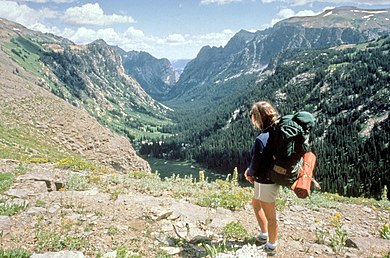
Hikers backpacking through Stein Valley Provincial Park in British Columbia.

People are drawn to backpacking primarily for recreation, to explore places that they consider beautiful and fascinating, many of which cannot be accessed in any other way. A backpacker can travel deeper into remote areas, away from people and their effects, than a day-hiker can. However, backpacking presents more advantages besides distance of travel. Many weekend trips cover routes that could be hiked in a single day, but people choose to backpack them anyway, for the experience of staying overnight.

These possibilities come with disadvantages. The weight of a pack, laden with supplies and gear, forces traditional backpackers to travel more slowly than day-hikers would, and it can become a nuisance and a distraction from enjoying the scenery. In addition, camp chores (such as pitching camp, breaking camp, and cooking) can easily consume several hours every day. However, with practice, much of this downtime can be purged from the day.

Backpackers face many risks, including adverse weather, difficult terrain, treacherous river crossings, and hungry or unpredictable animals (although the perceived danger from wild animals usually greatly exceeds the true risk). They are subject to illnesses, which run the gamut from simple dehydration to heat exhaustion, hypothermia, altitude sickness, and physical injury. The remoteness of backpacking locations exacerbates any mishap. However, these hazards do not deter backpackers who are properly prepared. Some simply accept danger as a risk that they must endure if they want to backpack; for others, the potential dangers actually enhance the allure of the wilderness.

Equipment
A small backpacking tent, for two people ("two-man")

Almost all backpackers seek to minimize the weight and bulk of gear carried. A lighter pack causes less fatigue, injury and soreness, and allows the backpacker to travel longer distances. Every piece of equipment is evaluated for a balance of utility versus weight. Significant reductions in weight can usually be achieved with little sacrifice in equipment utility, though very lightweight equipment can be significantly more costly.

A large industry has developed to provide lightweight gear and food for backpackers. The gear includes the backpacks themselves, as well as ordinary camping equipment modified to reduce the weight, by either reducing the size, reducing the durability, or using lighter materials such as special plastics, alloys of aluminium, titanium, composite materials, impregnated fabrics and carbon fiber. Designers of portable stoves and tents have been particularly ingenious. Homemade gear is common too, such as the beverage-can stove.

Some backpackers use lighter and more compact gear than do others. The most radical measures taken in this regard are sometimes called ultralight backpacking.

Due to the emphasis on weight reduction, a practical joke common in some circles is to secretly pack a small but relatively heavy luxury item, such as a soft drink, into another backpacker's pack. Then, once the group stops for a rest, the perpetrator retrieves the item, thanks the bearer for carrying it, and consumes it.

Water

Backpackers often carry some water from the trailhead, to drink while walking. For short trips, they may carry enough to last the whole trip, but for long trips this is not practical. A backpacker needs anywhere from 2 to 8 litre (roughly 1/2 to 2 U.S. gallons), or more, per day, depending on conditions, making a water supply for more than a few days prohibitively heavy. 1 litre (1.1 US qt) of water weighs 1 kilogram (2.2 lb).

Backpackers may carry one to four litres of water, depending on conditions and availability. Although some backpacking camps in heavily-used areas provide potable water, it must usually be obtained from lakes and streams or preferably springs.

According to health and medical experts, untreated water found in backcountry settings in the United States and Canada is generally quite safe to drink. Despite this, many backpackers believe that drinking and cooking water nearly always needs treatment with a filter or chemical tablets to protect against bacteria and protozoa (see wilderness diarrhea and Portable water purification).

If water is unavailable, or if the only water available is irreparably filthy, backpackers may need to carry large amounts of water for long distances.

Water may be stored in bottles or in soft, collapsible hydration packs (bladders). Some backpackers store water in ordinary plastic beverage bottles, while others use special Lexan bottles or metal canteens. For accessibility they may be carried by a shoulder strap or attached to the outside of a pack. Bladders are typically made of plastic, rubber, and/or fabric. They are light, easily stored and collapsible. They may be equipped with drinking hoses for easy access while hiking. In spite of this convenience, bladders are more prone to leaking than bottles, particularly at the hose connections. Hoses also allow the hiker to lose track of the water supply in the bladder and to deplete it prematurely.

Food
An atypical backcountry kitchen (few backpacking camps feature grills like the one shown).
See also: outdoor cooking and nutrition

Some backpackers enjoy cooking elaborate meals with fresh ingredients, particularly on short trips, and others carry the gear and take the time to catch fish or hunt small game for food. However, especially for long expeditions, most backpackers' food criteria are roughly the same: high food energy content, with long shelf life and low mass and volume. An additional concern is weight; while Dutch oven and campfire cookery are historically popular, small liquid-fuel campstoves and ultralight cooking pots made of aluminum or titanium are more common in modern usage due to weight limitations and fire restrictions in many locales.

Ordinary household foods used on backpacking trips include cheese, bread, sausage, fruit, peanut butter, and pasta. Popular snack foods include trail mix, easily prepared at home; convenient and nutritious energy bars, chocolate, and other forms of candy, which provide quick energy and flavor. Traditional outdoor food includes dried foodstuffs such as jerky or pemmican, and also products like oatmeal (which can also be consumed raw in emergency situations).

Most backpackers avoid canned food, except for meats or small delicacies. Metal cans and their contents are usually heavy, and, many believe that, like all trash, the empties should be carried back out.

For dinners, many hikers use specially manufactured, pre-cooked food that can be eaten hot. It is often sold in large, stiff bags that double as eating vessels. One common variety of special backpacking food is freeze-dried food, which can be quickly reconstituted by adding hot water. One can also purchase a commercial food dehydrator which removes the majority of water from a pre-cooked meal. To eat, water is mixed in with the meal several hours before eating and allowed to rehydrate before heating. Some various distributors of this are Backpackers Pantry and Mountain Outfitters. Another kind of special backpacking food is UHT-packaged without dehydration, and can be reheated with a special, water-activated chemical heater. This technology originated with the U.S. military's Meal Ready-to-Eat ("MRE"), but is now produced also for the commercial market. The small chemical heater obviates the need for a portable stove and fuel, however the added weight of the MRE's and their packaging reduce the weight advantage. MRE's can be useful to backpackers for several reasons:

* They do not need to be rehydrated or heated which is useful in areas where flame is not allowed, and water is scarce (Most of Australia)
* They are very durably packaged
* A single MRE contains a full meal complete with snack and dessert
* They offer a great deal of variety in each meal, including condiments
* They are individually packaged inside the "brown plastic wrapper", so you can place individual components in various pockets and "eat on the move".

As more and more "big box" retail stores carry pre-packaged dehydrated foods (such as Mountain House Brand) however, it is becoming increasingly easier to buy packaged meals retail versus mail order, whereas MRE's are rarely carried in retail stores.

There is a genre of cookbooks specializing in trailside food and the special challenges inherent in backcountry cooking. Most such cookbooks espouse one of two philosophies; the first, generally used on short trips, involves planning out meals and preparing many ingredients in one's home kitchen before departure. The second method, bulk rationing, simply supplies the hiker with ingredients, allowing on-trail cooking with minimal prior planning, and is sometimes used for extended outings. A third form of the genre deals in Dutch oven cookery, which has considerable historical cachet (especially in countries such as the United States with a long pioneer tradition), but is dependent on suitable locations for a campfire.

Winter backpacking

Although backpacking in the winter is rewarding, it can be dangerous and generally requires more gear. Backpackers may need skis or snowshoes to traverse deep snow, or crampons and an ice axe to cross ice in colder climates. Cotton clothing, which absorbs moisture and chills the body, is particularly dangerous in cold weather, so backpackers stick to synthetic materials or materials that won't hold moisture. Special low-temperature sleeping bags and tents can be expensive, but will be more comfortable than many layers of warm clothing. However when hiking in cold weather it is always better to hike with varying layers of clothing so that as the body heats up layers can be taken off without causing the wearer to sweat or become very chilled.

Skills and safety
Main article: Hazards of outdoor activities

* Survival skills are handy for peace of mind: In case the weather, terrain or environment is more challenging than prepared for, or for dealing with shortcomings in
* Navigation and orienteering are useful to find the trailhead, then find and follow a route to a desired sequence of destinations, and then an exit. In case of disorientation, orienteering skills are important to determine where you are and formulate a route to somewhere more desirable. At their most basic, navigation skills allow you to choose the correct sequence of trails to follow.
* First Aid: effectively dealing with minor injuries (splinters, punctures, sprains) is considered by many a fundamental backcountry skill. More subtle, but maybe even more important, is recognizing and promptly treating hypothermia, heat stroke, dehydration and hypoxia, as these are rarely encountered in daily life.
* Leave No Trace is the backpacker's version of the golden rule: To have beautiful and pristine places to enjoy, help make them. At a minimum, don't make them worse.
* Distress signaling is a skill of last resort.

From http://en.wikipedia.org/

Backpacking (wilderness)

Backpacking (wilderness)

Backpacking (in US; tramping, trekking, or bushwalking in other countries) combines hiking and camping in a single trip. A backpacker hikes into the backcountry to spend one or more nights there, and carries supplies and equipment to satisfy sleeping and eating needs.

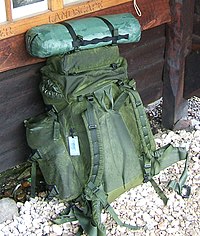
A backpacker packs all of his or her gear into a backpack. This gear must include food, water, and shelter, or the means to obtain them, but very little else, and often in a more compact and simpler form than one would use for stationary camping. A backpacking trip must include at least one overnight stay in the wilderness (otherwise it is a day hike). Many backpacking trips last just a weekend (one or two nights), but long-distance expeditions may last weeks or months, sometimes aided by planned food and supply drops.

Backpacking camps are more spartan than ordinary camps. In areas that experience a regular traffic of backpackers, a hike-in camp might have a fire ring and a small wooden bulletin board with a map and some warning or information signs. Many hike-in camps are no more than level patches of ground without scrub or underbrush. In very remote areas, established camps do not exist at all, and travelers must choose appropriate camps themselves.

In some places, backpackers have access to lodging that is more substantial than a tent. In the more remote parts of Great Britain, bothies exist to provide simple (free) accommodation for backpackers. Another example is the High Sierra Camps in Yosemite National Park. Mountain huts provide similar accommodation in other countries, so being a member of a mountain hut organization is advantageous (perhaps required) to make use of their facilities. On other trails (e.g. the Appalachian Trail) there are somewhat more established shelters of a sort that offer a place for weary hikers to spend the night without needing to set up a tent.

Most backpackers purposely try to avoid impacting on the land through which they travel. This includes following established trails as much as possible, not removing anything, and not leaving residue in the backcountry. The Leave No Trace movement offers a set of guidelines for low-impact backpacking ("Leave nothing but footprints. Take nothing but photos. Kill nothing but time. Keep nothing but memories").

From http://en.wikipedia.org/